In the Facebook Ads industry, you may have come across terms like VIA accounts, Clone accounts, and specific notations such as Profile Green 2-Line and Profile 902 Green 3-Line. These profiles are widely used by advertisers, agencies, and resellers to restore ad access after restrictions.
This article breaks down the real difference between a profile 2-line and a profile 3-line, and why they matter for running Facebook Ads.

What is VIA vs Clone?
-
VIA: A Facebook profile with full information (username, password, 2FA key, email, email password, etc.). These are usually stronger and more stable accounts.
-
Clone: A newly created Facebook profile (1–90 days old), typically made by computer. These are not real user accounts and are mostly used to create BM (Business Manager), Ads, or Pages.
What Is A Profile Green 2 Lines (Profile 2-line)
Profile 2-lines means the account has passed Facebook identity verification.
When checking Account Quality, you’ll see:
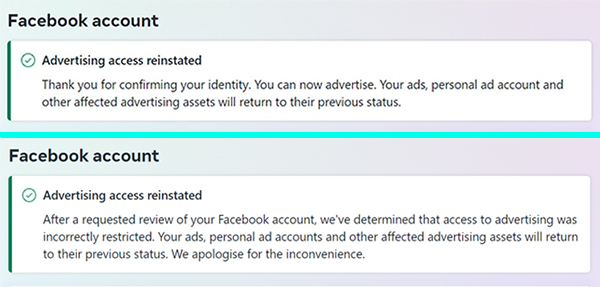
“Advertising access reinstated”
“Thank you for confirming your identity. You can now advertise. Your ads, personal ad account and other affected advertising assets will return to their previous status.”
Key Features of Profile 2-Line:
-
High trust score and low chance of checkpoints.
-
Smooth process to create BM, add payment methods, and launch ads.
-
Great for new advertisers and entry-level campaigns.
-
Typically cheaper than VIA 902, making it cost-effective.

What Is A Profile 902 Green 3 Lines (Profile 3-line)
Profile 902 3-lines refers to accounts that were once flagged with Error 902 (advertising restriction due to policy violation or suspicious activity), but later successfully appealed.
At Account Quality, you’ll see:
“Advertising access reinstated”
“After a requested review of your Facebook account, we’ve determined that access to advertising was incorrectly restricted. Your ads, personal ad accounts and other affected advertising assets will return to their previous status. We apologise for the inconvenience.”
Key Features of Profile 3-Line:
-
Stronger resistance to future checkpoints.
-
Considered more “battle-tested” because Facebook manually reviewed and approved the account.
-
Often chosen by experienced advertisers running high-risk industries or scaling large campaigns.
-
Usually more expensive, but delivers better long-term stability.

Comparison Profile Green 2-Line & Profile Green 3-Line
| Feature | Profile Green 2 Lines (VIA XMDT) | Profile 902 Green 3 Lines (VIA 902) |
|---|---|---|
| Verification | Passed Facebook Identity Check (XMDT) | Previously restricted, appealed successfully |
| Trust Level | High, clean history | Very high, proven resilient |
| Checkpoint Resistance | Good | Excellent |
| Best For | Beginners, regular ad campaigns | Advanced advertisers, high-risk niches |
| Price | More affordable | More expensive |
| Campaign Usage | Testing, normal scaling | Long-term, scaling, sensitive products |
Pros and Cons
✅ Advantages of VIA 2-line
-
High reliability from the start.
-
Easier login with low account lock risk.
-
Clean activity history → safe for long-term ads.
-
More budget-friendly.
✅ Advantages of VIA 3-line
-
Strong checkpoint resistance.
-
Stable for “difficult” niches and big campaigns.
-
Reviewed and approved by Facebook → higher trust.
-
Preferred by pro advertisers scaling aggressively.
Which Should You Choose?
-
Choose VIA XMDT (2-line): if you’re new to Facebook Ads, running general products, and want a low-cost entry point.
-
Choose VIA 902 (3-line): if you’re an experienced advertiser, scaling campaigns, or working in sensitive niches where Facebook is stricter.
-
Many advertisers use a hybrid strategy: VIA XMDT for testing campaigns, and VIA 902 for main campaigns.
Conclusion
Both Profile Green 2 Lines (Profile 2-line) and Profile 902 Green 3 Lines (Profile 3-line) provide access to Facebook Ads, but serve different needs. VIA XMDT offers affordability and stability for new advertisers, while VIA 902 provides superior durability for advanced campaigns. Choosing the right profile depends on your goals, budget, and risk tolerance.